Quick answer
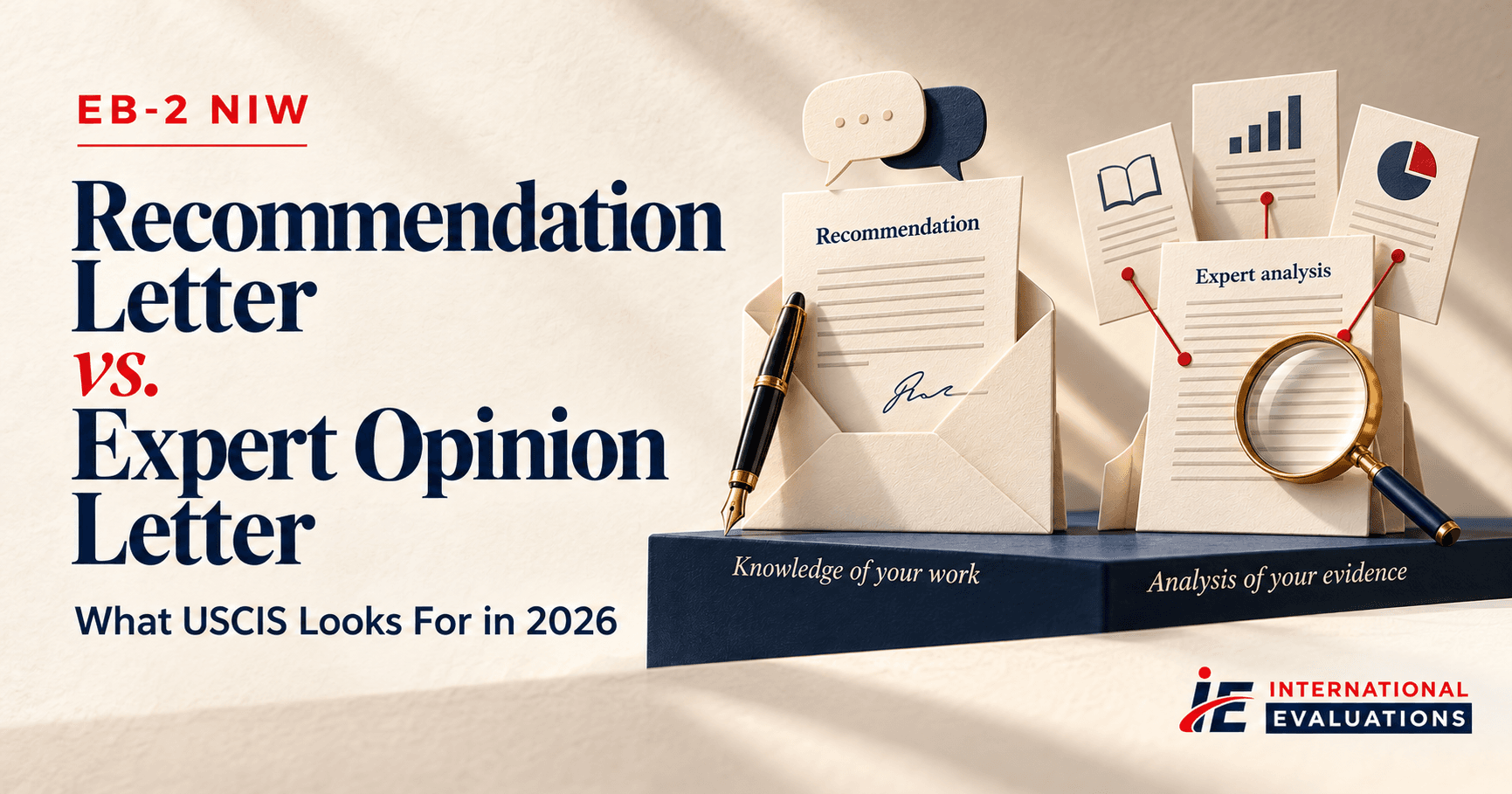
A recommendation letter is testimony from someone who knows the petitioner's work first-hand — a supervisor, collaborator, or client. An expert opinion letter is an independent analysis by a qualified specialist who reviews the record and explains, prong by prong, why the work meets the Matter of Dhanasar standard. Both help an EB-2 National Interest Waiver (NIW) petition, but neither proves eligibility on its own.
- USCIS treats letters as advisory, not binding. Under Matter of Caron International (1988), an officer may give an expert letter little weight if it conflicts with the record or is questionable.
- Letters corroborate; documents prove. Since USCIS's January 15, 2025 Policy Manual update, letters are most persuasive when they come from experts with first-hand knowledge, give specific examples, and "are supported by other independent evidence."
- Scrutiny is rising. NIW approval rates fell from 79.6% in FY2023 to 49.1% in FY2026 Q1–Q3, and since August 5, 2026 officers may deny without first issuing an RFE. Letters must be right at filing.
The rest of this guide explains how each letter works, what makes an expert credible, and what officers are flagging in 2026.
NIW basics: the Dhanasar test and where letters fit
The EB-2 NIW lets an advanced-degree professional or a person of exceptional ability self-petition for a green card without a job offer or PERM labor certification. Officers apply the three-prong test (explained in our EB-2 NIW requirements guide) from Matter of Dhanasar, 26 I&N Dec. 884 (AAO 2016):
- Substantial merit and national importance — the proposed endeavor matters beyond one employer or client.
- Well positioned to advance the endeavor — the petitioner's education, track record, plans, and progress show they can deliver.
- On balance, waiving the job offer benefits the United States.
Before any of this, the petitioner must first qualify for EB-2 (advanced degree or exceptional ability). That threshold is where a credential evaluation does its work; the letters do most of their work on prongs 1 and 2.
The standard of proof is a preponderance of the evidence — "more likely than not" (Matter of Chawathe, 25 I&N Dec. 369 (AAO 2010)). Letters help tip that balance by explaining what the documents mean. They cannot replace the documents.
What is an NIW recommendation letter?
A recommendation letter (also called a letter of support or reference letter) is first-hand testimony. The writer has worked with, supervised, funded, or used the petitioner's work, and describes what they personally saw.
There are two kinds, and officers weigh them differently:
- Dependent letters come from people with a direct tie: a PhD advisor, current or former employer, co-author, or business partner. They carry the richest detail but are the most likely to be discounted as not independent.
- Independent letters come from people who know the work only through its reputation — a researcher who cited the petitioner's paper, a company that adopted their method, an agency that relied on their data. They carry more weight because the writer had no stake in the outcome.
A strong recommendation letter answers four questions: How do you know the petitioner? What exactly did they do? What changed because of it? Why does it matter beyond your organization?
What is an NIW expert opinion letter?
An expert opinion letter is an independent, analytical assessment written by a recognized authority — often a senior university professor or industry leader — who has reviewed the petitioner's record. Its job is to interpret, not to praise.
A well-built expert opinion letter:
- States the expert's qualifications and attaches a CV.
- Lists every document reviewed (CV, publications, citation reports, patents, contracts, business plan).
- Discloses any relationship with the petitioner, or confirms there is none.
- Analyzes the endeavor against each Dhanasar prong, explaining why the field and the specific work are nationally important.
- Places the petitioner's results in context — for example, how a citation count compares with peers in the same subfield and career stage.
Officers are generalists. A specialist who can explain why a novel battery chemistry or a rural telehealth model matters nationally fills a knowledge gap the officer cannot fill alone. That is the expert letter's unique value.
Recommendation letter vs. expert opinion letter: side by side
The core difference is the basis of knowledge: a recommendation letter says what I saw; an expert opinion letter says what the evidence means.
| Feature | Recommendation letter | Expert opinion letter |
|---|---|---|
| Writer | Supervisor, collaborator, client, user of the work | Independent specialist, often a senior professor |
| Basis of knowledge | Personal, first-hand experience | Review of documents plus field expertise |
| Relationship to petitioner | Often direct (dependent) or reputation-only (independent) | Usually none; must be disclosed if any |
| Main purpose | Prove specific contributions and their impact | Interpret the record against the Dhanasar prongs |
| Strongest on | Prong 2 (well positioned) | Prongs 1 and 2 (national importance, positioning) |
| Typical weakness | Bias, generic praise, template wording | No first-hand knowledge; can read as paid advocacy |
| How many | Usually 3–6 | Usually 1–2 |
| Legal weight | Testimony, weighed for credibility | Advisory opinion (Matter of Caron) |
Why both letters matter
The two letters do different jobs, and a strong NIW petition usually needs both. Recommendation letters supply facts only insiders know; the expert letter explains why those facts meet the legal standard.
Recommendation letters matter because they:
- Document contributions that are invisible on paper, such as an internal system that cut costs or a protocol a hospital adopted.
- Show that others rely on the petitioner's work — the "used, adopted, funded, or cited" evidence officers now ask for.
- Provide independent validation when they come from outside the petitioner's own circle.
Expert opinion letters matter because they:
- Translate technical work into plain terms for a non-specialist officer.
- Connect the endeavor to national priorities, such as critical and emerging technologies, public health, or infrastructure.
- Benchmark the petitioner against peers, turning raw numbers into meaningful comparisons.
- Organize scattered exhibits into one argument mapped to the three prongs.
Used together, they give the officer two angles on the same claim: someone who saw the impact, and someone qualified to judge it.
How to judge an expert's qualifications
The right expert is defined by relevance, not just rank: a Nobel laureate in physics adds little to a petition about supply-chain software. Check each of these before you commission or accept a letter.
| Qualification | What to look for | Red flag |
|---|---|---|
| Subject-matter fit | Expertise in the petitioner's specific subfield, not just the broad discipline | Generalist writing outside their area |
| Seniority | Tenured or full professor, department chair, senior scientist, or recognized industry leader | Junior title with no record of evaluating others |
| Verifiable record | Peer-reviewed publications, citations, grants, patents, editorial or review roles | Credentials that can't be checked online |
| Institutional standing | Accredited U.S. university, national lab, major company, or government body | Unknown or unaccredited institution |
| Independence | No employment, co-authorship, or financial tie, or a clear disclosure of any tie | Undisclosed relationship found elsewhere in the record |
| Evaluation experience | Has served on hiring, tenure, grant, or peer-review panels | No history of judging others' work |
| Clean usage history | Writes thoughtful, case-specific letters | Signs near-identical letters for many petitioners |
Always attach the expert's CV and a short paragraph on how they became familiar with the petitioner's work. Officers cannot weigh a credential they cannot see.
What USCIS officers look for in NIW letters
Officers weigh every letter for relevance, reliability, and probative value. The January 15, 2025 Policy Manual update sets the benchmark: letters "may be persuasive when they are from experts in the person's field who have first-hand knowledge of the person's achievements, describe those achievements, provide specific examples of how the person is well positioned to advance the person's endeavor, and are supported by other independent evidence" (as quoted by WeGreened).
In practice, officers check for:
- Specificity. Named projects, dates, figures, and outcomes — not adjectives like "brilliant" or "world-class."
- A stated basis of knowledge. How the writer knows the work. An expert letter that never says what was reviewed is a common RFE target.
- Petitioner-level analysis. Letters that praise the importance of the field instead of this person's contribution are discounted.
- Independence and disclosure. Letters only from employers and co-authors draw "not independent" objections.
- Original wording. Notably similar language across letters can be treated as a reason to doubt them (Matter of R-K-K-, BIA 2015).
- Consistency with the record. A claim the exhibits don't back up can lower the weight of the whole letter.
- Prong mapping. Clear links between the letter's statements and each Dhanasar prong.
Letters from U.S. government agencies and quasi-governmental bodies, such as national labs, continue to carry significant weight, according to practitioners reviewing the 2025 guidance.
Can these letters be used as corroborative evidence?
Yes — and in 2026 that is their main role. Letters work best as corroborating evidence that explains and confirms primary documents, not as standalone proof.
The controlling rule comes from Matter of Caron International, 19 I&N Dec. 791 (Comm'r 1988): USCIS may use expert statements as advisory opinions, but where an opinion conflicts with other information or is questionable, it may give that opinion less weight or none. Letters are not presumptive proof of eligibility.
The other side of the rule matters too. Courts have held that USCIS cannot simply ignore detailed expert letters. In Chursov v. Miller (S.D.N.Y. 2019), the agency acted arbitrarily when it failed to examine opinion letters for evidence of significance. And under Matter of Skirball Cultural Center (AAO 2012), uncontested expert testimony was treated as reliable and probative.
How to pair letters with primary evidence:
| Claim in the letter | Document that corroborates it |
|---|---|
| "Her method is used across the industry" | Adoption agreements, licensing contracts, client letters |
| "His research is highly influential" | Citation report with field benchmarks, citing articles |
| "The work advances a national priority" | Federal reports, agency strategies, funding announcements |
| "She led the project" | Patent listing as inventor, grant records naming her as PI |
| "The venture will create jobs" | Business plan, signed contracts, investor commitments |
Every claim in a letter should point to an exhibit. If a claim has no exhibit, cut it or find the evidence.
USCIS trends on NIW letters in 2025–2026
The NIW approval rate has fallen every fiscal year since FY2022, and officers are giving letters less benefit of the doubt. Approval rates below are approvals ÷ (approvals + denials), computed by practitioners from USCIS's quarterly I-140 data (Locke Immigration; Ashoori Law). USCIS does not publish an NIW-specific rate, and FY2026 is a partial year.
NIW approval rate has roughly halved since FY2022
EB-2 NIW I-140 approvals ÷ (approvals + denials)
Source: USCIS Form I-140 quarterly data; rates computed by Ashoori Law (FY2022) and Locke Immigration (FY2023–FY2026 Q1–Q3). FY2026 is a partial year.
What officers are doing differently with letters:
- Documentation over description. A July 2026 post on AILA's Think Immigration blog, by attorney Remzi Kulen, put it plainly: expert letters "still matter, but only when they come from people with first-hand knowledge," and they must be backed by independent proof (AILA Think Immigration).
- Evidence of uptake. Officers want proof that others have used, adopted, funded, or cited the work — not just credentials and plans.
- Past results over forecasts. Officers are directed to look at documented past achievements rather than rely mainly on predictions of future success (RN Law Group).
- Field praise is discounted. Letters about why AI or cancer research matters, rather than why this petitioner's work matters, draw RFEs.
- No second chance. Since August 5, 2026, USCIS officers have full discretion to deny without first issuing an RFE or NOID, including for pending cases (Womble Bond Dickinson). A weak letter may now end a case instead of triggering a request to fix it (see what the August 2026 evidence standard means).
One caution: some of the decline likely reflects volume. Filings roughly tripled from FY2022 to FY2025, so the pool includes more marginal cases. The quarterly rate has also started to recover, from a low of 35.7% in FY2025 Q4 to about 55% in FY2026 Q3. A well-documented petition is judged on its own record.
Checklist: NIW letters that hold up in 2026
With denials now possible without an RFE, run every letter through this list before filing, or have it checked in a pre-filing documentation review.
- At least half the letters come from independent writers with no employment, co-authorship, or financial tie.
- Each writer states how they know the work and attaches a CV or bio.
- Any relationship with the petitioner is disclosed, with its nature and dates.
- Each letter covers a different contribution, so no two read alike.
- Every claim names a specific project, figure, date, or outcome.
- Every claim points to an exhibit that corroborates it.
- The expert opinion letter lists all documents reviewed.
- The expert letter addresses each Dhanasar prong by name.
- Letters discuss the petitioner's own impact, not just the importance of the field.
- Citation or usage figures are benchmarked against peers.
- Nothing in any letter conflicts with the CV, petition letter, or business plan.
- The underlying EB-2 eligibility (degree equivalency or exceptional ability) is documented separately, including a credential evaluation for foreign degrees.
Need an independent expert for your NIW?
International Evaluations matches EB-2 NIW petitions with independent experts in the petitioner's specific field, from our network of 350+ U.S. professors and industry experts. Each letter is written for your case, maps the record to the Dhanasar prongs, and is cross-checked against your other exhibits.
Get an NIW expert opinion letter Book a free consultationCall +1 (510) 876-0900 or email info@internationalevaluations.com. Immigration attorneys: see our Attorney Partner Program.
Frequently asked questions
What is the difference between an NIW recommendation letter and an expert opinion letter?
A recommendation letter is first-hand testimony from someone who knows the petitioner's work. An expert opinion letter is an independent specialist's analysis of the record against the Dhanasar three-prong test.
How many recommendation letters do I need for an EB-2 NIW?
No rule sets a number. Most petitions include three to six recommendation letters and one or two expert opinion letters. Quality, independence, and corroboration matter more than count.
Do NIW recommendation letters have to be from independent experts?
No, but independent letters usually carry more weight. Letters from advisors, employers, or co-authors are accepted and often give the best detail, but they should be balanced by writers with no direct tie.
Is an expert opinion letter binding on USCIS?
No. Under Matter of Caron International (1988), USCIS treats expert letters as advisory opinions. Officers may give them less weight if they conflict with the record or are questionable.
Can recommendation letters be used as corroborating evidence?
Yes. Letters are strongest when they corroborate primary evidence such as publications, citations, patents, contracts, and funding records. Letters alone rarely establish eligibility.
What qualifications should an NIW expert have?
Deep expertise in the petitioner's specific subfield, senior standing at a recognized institution, a verifiable publication or professional record, experience evaluating others' work, and independence from the petitioner.
Why are NIW petitions being denied more often in 2026?
Computed approval rates fell to about 49% in FY2026 Q1–Q3. Common grounds include vague endeavors, weak national-importance showings, conclusory letters, and thin objective evidence. Since August 5, 2026, officers may deny without an RFE.
Can I write my own recommendation letter for the writer to sign?
Drafting help is common, but officers notice template language. Notably similar wording across letters can undermine all of them. Each letter should reflect the writer's own knowledge and voice.
This article is general information, not legal advice. Work with a licensed immigration attorney on your specific petition. International Evaluations is not a law firm. Expert opinions reflect the independent judgment of the signing expert, and outcomes are not guaranteed.
Sources
- USCIS Policy Manual, Vol. 6, Part F, Ch. 5 — Advanced Degree or Exceptional Ability
- WeGreened — Breaking Down the Latest NIW Policy Updates (quotes January 15, 2025 guidance on letters)
- WeGreened — AAO Corrects Officer Interpretation of Support Letters (non-precedent AAO decision)
- Locke Immigration — "Your Support Letters Are Not Independent" (case law on letter weight)
- Locke Immigration — EB-2 NIW Approval Rates (USCIS I-140 data, accessed Oct. 5, 2026)
- Ashoori Law — EB-2 NIW Approval Rates Fell From 95.7% to 45.5% (45.5% = FY2026 first half)
- AILA Think Immigration (Remzi Kulen) — What the New NIW RFEs Are Really Asking For (July 21, 2026)
- RN Law Group — EB-2 NIW Adjudications After the January 2025 Update
- Womble Bond Dickinson — Policy Change Foretells Uptick in USCIS Denials (Aug. 6, 2026)