EB-1A in October 2026: A Faster Road for Indian Professionals, With Less Room for Error
EB-1 India is now 9+ years ahead of EB-2 India, but USCIS can deny EB-1A petitions without an RFE. What the October 2026 Visa Bulletin means for you.
Read More →Blog

Practical guidance on credential evaluations, expert opinion letters, and the documentation that keeps U.S. immigration petitions moving — written by the team that prepares it every day.
EB-1 India is now 9+ years ahead of EB-2 India, but USCIS can deny EB-1A petitions without an RFE. What the October 2026 Visa Bulletin means for you.
Read More →For entrepreneurs, investors, and business owners seeking U.S. visas, a well-prepared business plan is more than a formal document—it can be the key to approval.
Read More →When a U.S. employer files an H-1B petition, two important questions need to be addressed: whether the position qualifies as a specialty occupation and whether the beneficiary meets the requirements for that position.
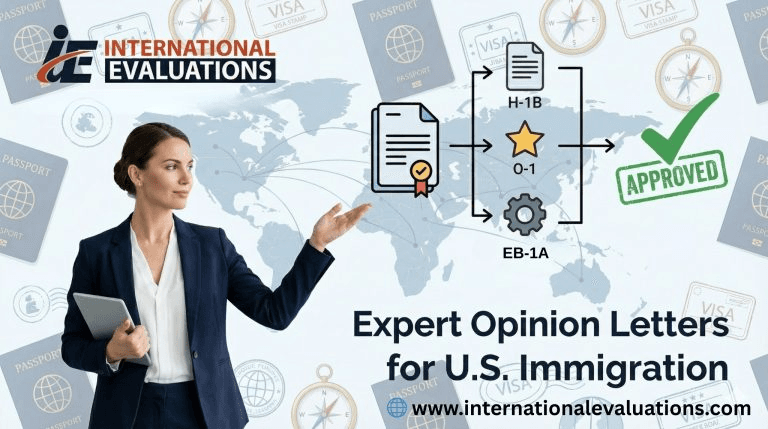
Read More →How Expert Opinion Letters Can Strengthen Weak Immigration Cases
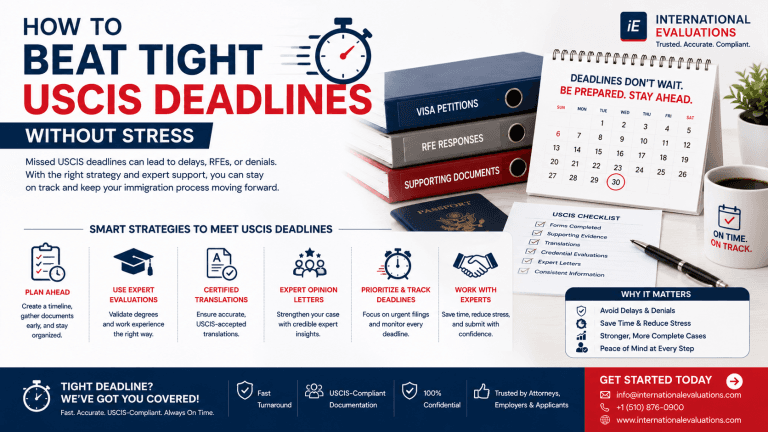
Read More →Managing multiple USCIS RFEs can be overwhelming. Learn practical strategies to track deadlines, prioritize cases, organize documentation, and use expert support to keep every RFE response on schedule.
Read More →Labor certification, commonly known as PERM, is a key step in many employment-based green card processes.
Read More →Learn how credential evaluations, certified translations, and expert opinion letters help build stronger documentation for USCIS immigration cases and support RFE responses
Read More →Learn how USCIS reviews foreign degree equivalency for immigration filings, and how accurate education evaluations help H-1B, EB-2, O-1, and PERM cases avoid documentation delays
Read More →Inaccurate or incomplete credential evaluations are one of the most common, and most preventable, causes of university admission delays. Here's how accurate, institution-ready evaluations keep your application on track.
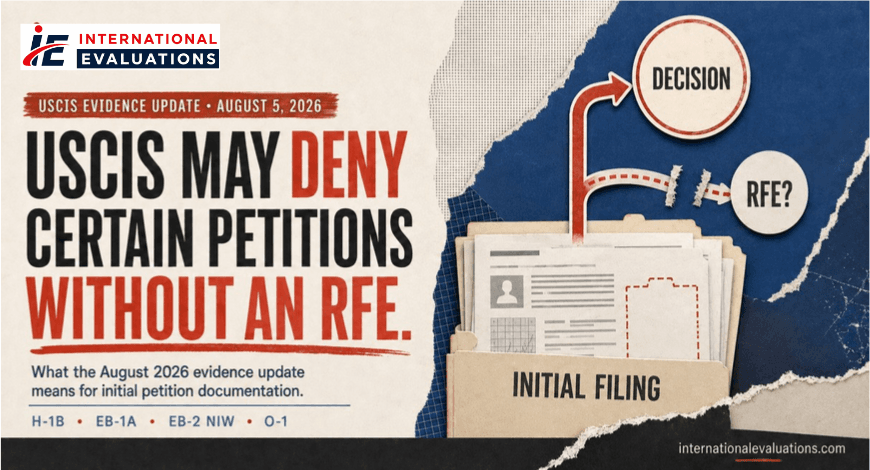
Read More →USCIS can now deny a case without ever issuing an RFE. See what changed on August 5, 2026, and how attorneys are adjusting first-filing documentation strategy.
Read More →PERM audits are on the rise in 2026, and even small documentation gaps can trigger denials or delays. Learn how International Evaluations helps immigration attorneys manage recruitment records, audit files, and compliance checks so firms stay audit ready without the paperwork burden.
Read More →Immigration attorneys don't lose cases over legal argument — they lose time to inconsistent job titles, unclear degree equivalency, and missing expert letters. Here's how outsourcing documentation and credential evaluation work keeps case files clean and frees attorneys to focus on strategy.
Read More →Attorney-reviewed evaluations, expert letters, and document checks that keep immigration filings consistent — so law firms spend less time on paperwork and more on case strategy.
Read More →What a compliant E-2 visa business plan needs — and why getting it delivered fast, not just written well, matters for investors on a deadline.
Read More →USCIS's August 2026 policy alert lets officers deny incomplete EB-1A, NIW, O-1, and H-1B petitions without issuing an RFE first — here's what your initial filing needs.
Read More →Missing or incomplete documents are quietly derailing H-1B hires — here's the checklist employers need to keep sponsorships on track.
Read More →Immigration paperwork can be confusing, especially when you are dealing with forms, supporting documents, education records, and work history all at once. Even a small mistake or missing document can lead to questions from USCIS, delays, or a Request for Evidence (RFE).
Read More →The PERM filing mistakes that trigger DOL audits and denials — and how employers can keep labor certification on track in 2026.
Read More →Receiving a Request for Evidence (RFE) from USCIS can feel stressful on its own. But when you have multiple RFEs pending — whether for different clients, employees, or visa types — the pressure can be overwhelming.
Read More →Receiving an RFE (Request for Evidence) from USCIS can be stressful for employers, attorneys, and foreign workers. Even the strongest petitions can face delays or denials if key documentation is missing or unclear.
Read More →When it comes to U.S. immigration, RFEs (Requests for Evidence) can derail even the strongest applications.
Read More →The PERM (Program Electronic Review Management) labor certification process is an important step in many employment-based permanent immigration cases. Through PERM, an employer must document the requirements of the offered position and establish that the foreign worker meets those requirements.
Read More →A foreign degree only works for USCIS if it's proven equivalent — here's how a credential evaluation does that.
Read More →In today’s competitive immigration landscape, tech employers and immigration attorneys are facing a growing challengean increase in Requests for Evidence (RFEs) from USCIS, particularly in H-1B and employment-based green card cases.
Read More →The H-1B visa process is already challenging, but sometimes applicants encounter unusual Requests for Evidence (RFEs). One of the more surprising trends is when USCIS asks for biometrics as part of an H-1B petition review.
Read More →Submitting documents in a foreign language without a proper certified translation is one of the fastest ways to trigger a Request for Evidence (RFE), slow your case, or even face a denial.
Read More →Receiving a Request for Evidence (RFE) from U.S. Citizenship and Immigration Services (USCIS) is typically synonymous with having hit a wall at warp speed.
Read More →Think you need a college degree to qualify for an H-1B visa? Think again. While a U.S. bachelor’s degree or its equivalent is the traditional path, there’s an alternative that many overlook: relevant work experience.
Read More →Getting closer to your dream of working or living in the U.S. is an exciting journey—but even strong visa petitions can sometimes hit unexpected hurdles.
Read More →Request for Evidence (RFE) for your EB2-NIW green card petition may feel like a setback—but it’s really an opportunity. It’s USCIS’s way of saying, “We see potential here, but we need more.”
Read More →Getting a Request for Evidence (RFE) back on your EB1A green card petition can be stressful—but it doesn’t mean the end of your case. An RFE is a second chance. It is the USCIS offering you an opportunity to present additional, compelling evidence to prove your eligibility.
Read More →The H1B visa is a non-immigrant visa that allows U.S. employers to hire foreign professionals in specialty occupations, typically requiring a bachelor’s degree or higher in specific fields like IT, engineering, finance, healthcare, or education.
Read More →Right now, Many individuals migrate across borders for employment, studies, or new life experiences, looking for better academic evaluation service.
Read More →The EB1A visa, or Extraordinary Ability Green Card, allows deserving individuals to gain permanent residency in the US.
Read More →The EB-2 is an employment-based immigration visa that allows applicants to secure U.S. Green Card status. To qualify, applicants must have an advanced degree or exceptional skills.
Read More →An Expert Opinion Letter (EOL) is a professional assessment prepared by a qualified expert with relevant knowledge or experience in a particular field.
Read More →The H1B visa is a non-immigrant visa that allows U.S. employers to hire foreign professionals in specialty occupations, typically requiring a bachelor's degree or higher in specific fields like IT, engineering, finance, healthcare, or education
Read More →In an increasingly globalized world, many individuals seek opportunities to further their education or career prospects in the United States.
Read More →In a world marked by increasing globalization, the pursuit of education knows no borders.
Read More →Do not know how to respond an request for evidence (RFE)? It is not difficult as in-case you don’t know, here are 6 things that can be helpful to you should know about an RFE.
Read More →The H-1B application season has begun during March and April, and you might require an evaluation of your academic credentials.
Read More →Are you looking to work in the United States of America? If yes, then you should be aiming for H1B jobs. The fact is, it requires you to be qualified and skilled for the specialty occupation list.
Read More →This nonimmigrant visa is for those who have extraordinary ability in science, arts, education, business, or athletics or who have proved a remarkable extraordinary achievement
Read More →The work experience evaluation is required when a consultant’s formal education is not equivalent to the minimum education requirement of the consultant’s prospective employment.
Read More →There have been many myths about foreign credential evaluation. Here, we are talking about some common myths that people have about credential evaluation.
Read More →Receiving a Request for Evidence (RFE) from U.S. Citizenship and Immigration Services (USCIS) can be stressful. It means USCIS is asking for additional information or evidence before making a decision on a pending immigration petition or application.
Read More →By definition, expert opinion letter is made by professors or distinguished industry authorities to provide an “Expert Opinion”. Generally, it is required for extraordinary ability petitions, responding RFE’s or cases that require the opinion of an expert.
Read More →For an H-1B petition, the beneficiary generally needs to qualify for the offered specialty occupation through a U.S. bachelor's degree or its equivalent in the required specialty.
Read More →What do you need to do, if you receive a Request for Evidence (RFE) letter from USCIS? The answer is you need to submit an expert opinion letter.
Read More →In EB-1A Extraordinary Ability and EB-2 National Interest Waiver (NIW) petitions, supporting letters play a critical role.
Read More →For students and professionals who want to pursue higher education or career opportunities in the U.S., it is essential to verify that their foreign degree meets U.S. academic standards.
Read More →For students, professionals, and immigrants seeking to use their foreign degrees in the U.S., credential evaluations are essential. They help U.S. universities, employers, and licensing boards understand how a foreign education compares to U.S. standards.
Read More →Receiving a Request for Evidence (RFE) from USCIS for your H-1B visa application can feel stressful and confusing. You’ve already spent months preparing, filing, and waiting—only to get a notice that says more proof is needed.
Read More →Applying for a U.S. visa or employment-based immigration benefit requires more than just strong credentials — it requires proof that your foreign education meets U.S. academic standards.
Read More →When it comes to U.S. immigration, even the strongest case can face a USCIS denial due to minor documentation issues or inconsistencies.
Read More →The PERM labor certification process is one of the most time-sensitive and documentation-heavy steps in the U.S. employment-based green card journey.
Read More →