
Most green cards need an employer to sponsor you. The EB-2 National Interest Waiver (NIW) lets you sponsor yourself, if you can prove your work matters to the country. The catch: what counts as "the national interest" is not fixed. In August 2026 the White House rewrote its official list of critical technologies, and some fields that were national priorities in 2024 quietly dropped off.
That shift lands in a tough market. In fiscal year 2022, USCIS approved roughly 96 out of every 100 NIW petitions it decided. By late 2025, more were being denied than approved. Approvals have climbed back to about 55% in the most recent quarter, but the margin for a weak petition is far smaller than it was.
This guide explains what an NIW is, which kinds of work tend to qualify, why the target keeps moving, and how to check whether your own work is in the national interest before you file.
What is a National Interest Waiver?
A National Interest Waiver is a request, filed on Form I-140, asking USCIS to skip the job offer and the Department of Labor's PERM labor certification that the EB-2 green card normally requires. Because no employer is needed, you can file for yourself.
You must still qualify for EB-2 first, in one of two ways:
Advanced degree professional: a U.S. master's degree or higher (or a foreign equivalent), or a bachelor's degree plus five years of progressive experience in the specialty.
Exceptional ability: expertise significantly above what is ordinarily seen in the sciences, arts, or business, shown through at least three of six regulatory criteria.
Foreign degrees must be shown to be equivalent to U.S. degrees. That is where a professional credential evaluation comes in, and since USCIS's January 2025 guidance, USCIS treats this underlying EB-2 eligibility as a threshold question before it ever reaches the national interest question.
Standard EB-2 (PERM) | EB-2 NIW | |
|---|---|---|
Job offer | Required | Not required |
Labor certification | Required | Waived |
Who files | U.S. employer | You (or an employer) |
What you must prove | Qualifications + no qualified U.S. worker available | Qualifications + your work benefits the nation |
The Dhanasar test: three questions USCIS asks
Since the 2016 precedent decision Matter of Dhanasar, every NIW is judged on three "prongs." You must win all three.
Is the proposed endeavor of substantial merit and national importance? This is about the work, not you. It must have impact beyond your employer or your local clients: on a field, an industry, public health, national security, or the economy at scale.
Are you well positioned to advance it? This is about you: your education, track record, plan, and progress so far. Credentials, publications, patents, funding, contracts, and expert letters live here.
On balance, would waiving the job offer and labor certification benefit the United States? Why is it better for the country to let you proceed now than to make you go through PERM?
The January 2025 Policy Manual update sharpened each prong. Three points matter most:
"My profession is important" is not enough. Being a nurse, engineer, or teacher in a shortage field does not by itself show national importance; the specific endeavor must.
Helping a big employer is not national impact. Even work for a national company must show benefits that reach beyond that company.
Letters and business plans need backup. USCIS now gives weight to independent, objective evidence that corroborates what recommenders and plans claim.
The Policy Manual also names objective signals of national importance: the White House Critical and Emerging Technologies (CET) list, R&D-intensive industries, priorities set in the President's annual budget, and a federal agency vouching for the work. Keep that list in mind. It is the key to the rest of this guide.
By the numbers: an NIW petition that became a coin flip
In FY2022, USCIS approved 95.7% of the NIW petitions it decided. By the fourth quarter of FY2025, it was denying more than it approved, for the first time in the published data.
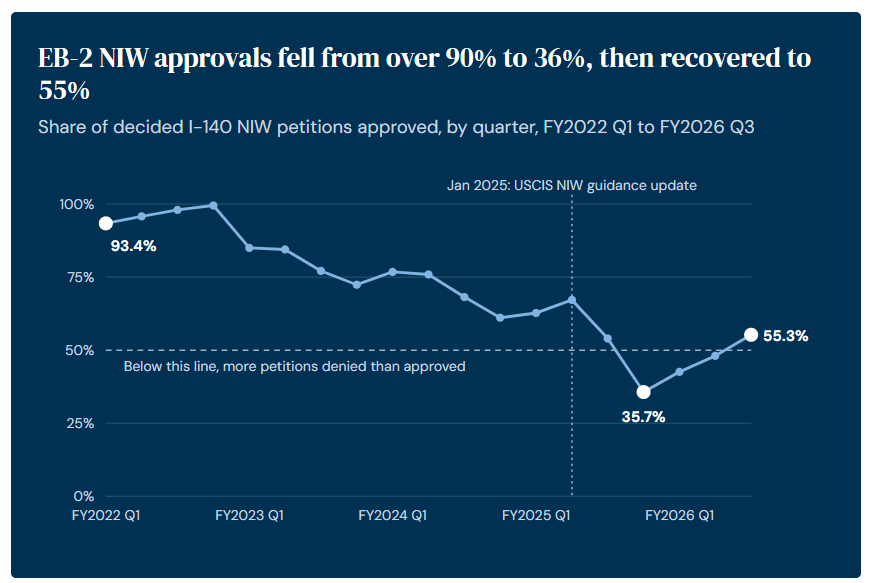
Source: USCIS Form I-140 adjudication data. Approval rate = approvals ÷ (approvals + denials), as calculated by Ashoori Law (FY2022 Q1 to FY2026 Q2) and Manifest Law (FY2026 Q3).
Volume is one major factor. Filings tripled, from 21,973 in FY2022 to 66,276 in FY2025, and the backlog of pending petitions passed 89,000. Rates have risen for three quarters in a row, but they are still roughly 40 points below where they started. Published rates differ by source because some divide approvals by filings received instead of by cases decided; the figures here use cases decided.
What kinds of work qualify as "in the national interest"?
No job title qualifies automatically. What qualifies is a specific endeavor with national importance. A documented national priority is one of the strongest ways to show it, but not the only one. The table shows where strong petitions usually find that link.
Area | Example endeavors | Where the "national" link comes from |
|---|---|---|
AI and autonomy | AI security and robustness research, autonomous systems, AI for manufacturing or defense | 2026 CET list; America's AI Action Plan |
Semiconductors and microelectronics | Chip design, integrated photonics, advanced packaging | 2026 CET list; domestic supply-chain policy |
Cybersecurity | Post-quantum cryptography migration, industrial-control-system security | 2026 CET list; June 2026 executive order on post-quantum cryptography |
Nuclear energy | Reactor design, fuel, grid integration of nuclear power | 2026 CET list (replaced the broader clean-energy category) |
Advanced manufacturing and materials | Digital twins, high-entropy alloys, substitutes for rare-earth materials | 2026 CET list; critical-minerals policy |
Biotechnology and health | Biomanufacturing, drug development, physicians in underserved areas | CET list; public-health data; physician NIW rules |
Space, quantum, sensing | Satellite systems, quantum computing, navigation and timing | CET list; defense and space strategy |
Entrepreneurship | A founder building a company in one of the areas above | Evidence of funding, accelerators, contracts, and reach beyond local job creation |
Non-STEM work can still qualify, for example in education policy, public health, or the arts. But it is harder in practice, because the petitioner must build the "national importance" case from scratch rather than point to a federal list.
The pattern in approvals is clear: a precise endeavor ("developing post-quantum encryption for water-utility control systems") beats a broad one ("working in cybersecurity").
The national interest keeps changing
In August 2026, the White House Office of Science and Technology Policy published a new National Security Science and Technology Strategy. Its appendix rewrote the Critical and Emerging Technologies list for the first time since February 2024, cutting it from 18 areas to 14.
Change | What happened |
|---|---|
Removed or narrowed | Clean energy generation and storage (replaced by a narrower Nuclear Energy area); advanced gas turbine engines; human-machine interfaces as a top-level area |
Dropped as subfields | Advanced cloud services; high-performance data storage and data centers; advanced modeling and simulation |
Added or newly named | Post-quantum cryptography; operational-technology and industrial-control-system security; integrated photonics; high-entropy alloys; hardened operating systems |
Merged | Robotics and uncrewed systems folded into "AI and Autonomy," which now also names multi-agent systems, continual learning, and AI security |
What this means in practice: a battery-storage researcher who leaned on the 2024 list in a petition drafted last spring now cites a category that no longer exists as written. That does not make the work unimportant, and the list itself says it is not exhaustive. But that petition now needs a different, current source for its national importance argument.
The CET list is only one input. National priorities also shift with:
Executive orders and national strategies, such as America's AI Action Plan (July 2025) and the June 2026 executive order on post-quantum cryptography.
The President's annual budget, which the Policy Manual names as an objective signal of national importance.
Agency funding calls from NSF, DOE, NIH, DARPA, and others, which show where money and attention are flowing.
Congressional legislation, such as funding for domestic chip production.
USCIS policy itself, which can change how evidence is weighed without changing the law.
A change in federal priorities does not change the legal test, but an officer reads your evidence in today's context. A case built on last year's framing can look stale on arrival.
How to tell whether your work is in the national interest
Treat national importance like a stock price: check it before you file, and again before you answer any request from USCIS. Here is what to watch.
Sources to monitor
The current White House CET list (now in the August 2026 National Security Science and Technology Strategy)
White House executive orders and national strategies in your field
The President's budget request and the R&D priorities memo from OMB and OSTP
Funding announcements from the federal agency closest to your work (NSF, DOE, NIH, DoD, NASA, USDA)
USCIS Policy Manual, Volume 6, Part F, Chapter 5, and USCIS policy alerts
Quarterly USCIS I-140 approval data, to see how strictly officers are reading the rules
Questions to ask yourself
Can I describe my endeavor in one specific sentence, not a job title?
Does a current federal document name my field, problem, or technology as a priority?
Does my impact reach beyond one employer or my own clients?
Do I have independent evidence (citations, contracts, funding, adoption, media) and not just letters?
Are my foreign degrees properly shown to equal the U.S. degree I am claiming?
If my field was reframed in the latest policy, have I updated my argument to match the new language?
If you answer "no" or "not sure" to two or more, fix the evidence first. Filing later with a strong case beats filing now with a weak one.
Why your first filing now has to be your best
On August 5, 2026, USCIS issued Policy Alert PA-2026-05. It lets officers deny a petition outright when the initial evidence does not show eligibility, without first sending a Request for Evidence (RFE). It also raises the stakes on any RFE you do receive, since a complete response is expected the first time.
The legal test for the NIW did not change. What changed is the safety net. Before, a gap in your evidence often meant a second chance. Now it can mean a denial, a new filing fee, and months lost while your priority date stands still.
That makes pre-filing work the most valuable part of the process: confirming your degree equivalency, aligning your endeavor with current priorities, and having independent experts assess your contributions before USCIS does.
Frequently asked questions
Can I apply for the EB-2 NIW by myself?
Yes. The NIW is a self-petition, so no employer is required. Given current approval rates, most applicants work with an immigration attorney and supporting experts.
What is a "proposed endeavor" in an EB-2 NIW?
It is the specific work you plan to do in the United States, described concretely enough that an officer can judge its impact. "Researching AI" is a field. "Building tools that detect adversarial attacks on medical-imaging AI" is an endeavor.
How do I prove national importance for an EB-2 NIW?
Connect your endeavor to current federal priorities (the CET list, executive orders, budget priorities, agency funding) and show impact that reaches beyond one employer. Back it with independent evidence, not only recommendation letters.
Can I file an EB-2 NIW while on an H-1B?
Yes. Many NIW petitioners are on H-1B or other work visas. Filing does not by itself change your current status.
Can I apply from outside the United States?
Yes. After approval, applicants abroad complete the process through a U.S. consulate instead of adjusting status inside the country.
Is the EB-2 NIW current for India?
No. India-born applicants face a long backlog in EB-2. In the October 2026 Visa Bulletin, the EB-2 India final action date is November 1, 2013, and the date for filing is January 15, 2015. An approved NIW waives the job offer and PERM, but it does not move you ahead in this queue. Applicants who also qualify for EB-1A, where the India final action date is February 1, 2023, may want to compare both routes. Check the State Department's monthly Visa Bulletin before planning your timeline.
Can I upgrade from EB-2 PERM to EB-2 NIW?
You can file an NIW alongside or after a PERM-based petition. In many cases you may keep the earlier priority date. Ask your attorney how this applies to your case.
How long does an EB-2 NIW take?
Standard I-140 processing has commonly run about 8 to 14 months or longer. Premium processing (fee of $2,965 since March 1, 2026) shortens the I-140 decision, but not the visa backlog that follows.
How International Evaluations helps
International Evaluations works with immigration attorneys and individual petitioners on the evidence behind an NIW, before it reaches USCIS:
Credential evaluations that establish the U.S. equivalency of your foreign degree, and of your progressive experience where your EB-2 claim relies on it.
Expert opinion letters from our network of 350+ professors at UC campuses, Ivy League schools, and other leading U.S. universities, matched personally to your field.
Pre-filing evidence review to find gaps before an officer does, now that a weak first filing can be denied without an RFE.
RFE response support and business plans for founders and entrepreneurs.
Every evaluation and letter is written for your case, never from a template.
Not sure whether your work fits today's national priorities? Call us at +1 (510) 876-0900 or email info@internationalevaluations.com.
International Evaluations is not a law firm and does not provide legal advice. Please consult a licensed immigration attorney about your specific case.
Sources
Summary of the August 2026 CET list changes (Tom's Hardware)
White House National Security Science and Technology Strategy, August 2026
PA-2026-05 analysis (Reddy Neumann Brown)
EB-2 NIW approval rate data FY2026 (Manifest Law)
EB-2 NIW approval rate history (Ashoori Law)
FY2025 Q4 approval rate analysis (Legal Services Inc.)
Premium processing fee, 2026 (Musani Law)