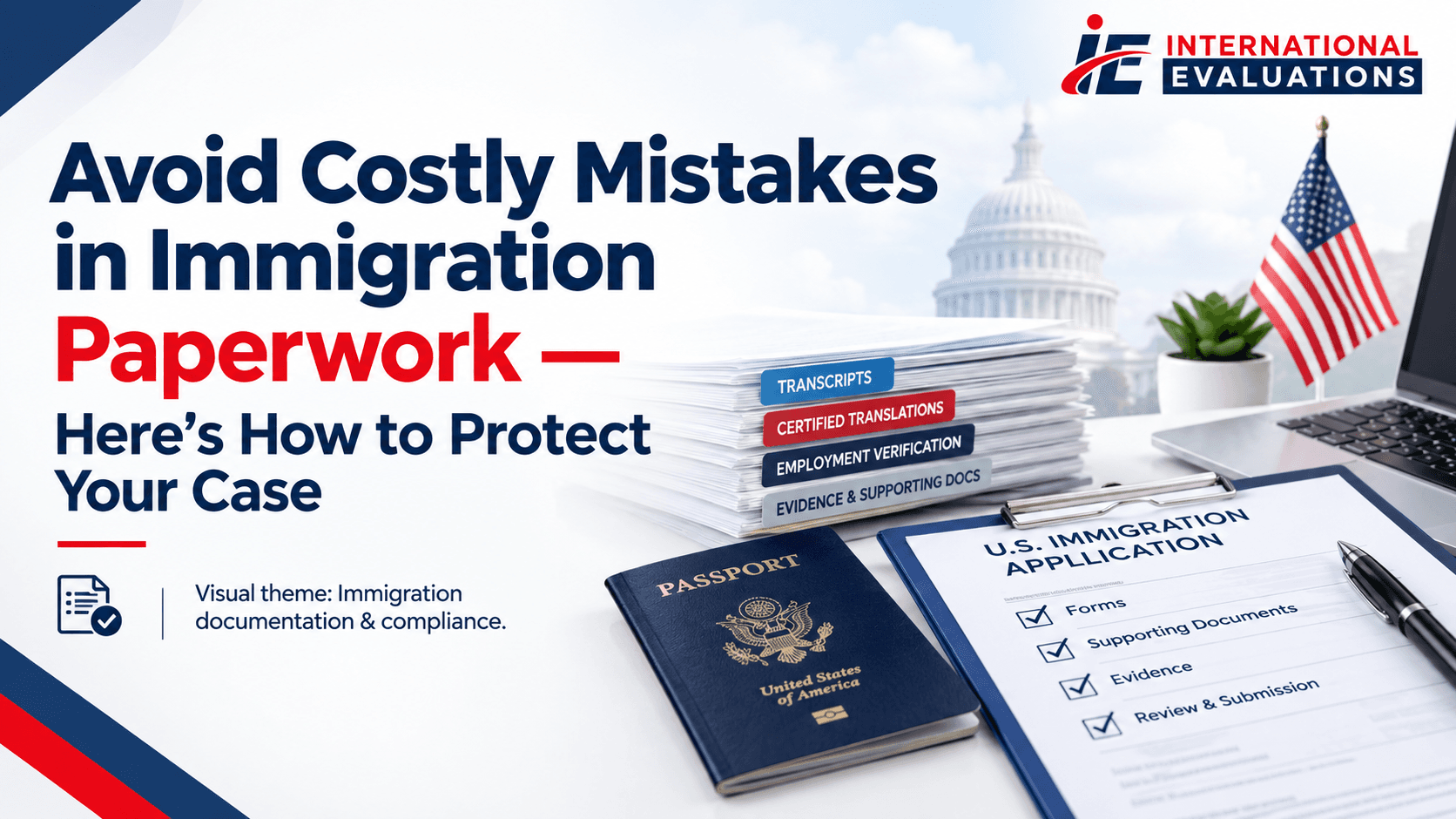
Immigration paperwork can be confusing, especially when you are dealing with forms, supporting documents, education records, and work history all at once. Even a small mistake or missing document can lead to questions from USCIS, delays, or a Request for Evidence (RFE).
That is why it is worth taking the time to review your documents carefully before submitting an immigration application or petition.
At International Evaluations, we provide professional documentation support, including credential evaluations, work experience evaluations, and expert opinion letters that may be relevant to certain immigration matters. Here are some common mistakes to look out for when preparing your paperwork.
Why Do Paperwork Mistakes Happen?
Immigration paperwork mistakes can happen for many different reasons. Sometimes a document is simply forgotten. Other times, information may be entered differently on different forms.
Some common examples include:
Missing documents: Important forms, transcripts, certifications, employment records, or other supporting evidence may be left out.
Incorrect information: A misspelled name, incorrect date, or inconsistent employment history can create unnecessary questions.
Unclear eligibility requirements: Each immigration category has its own requirements. Using the wrong form or submitting evidence that does not address the applicable requirements can create problems.
Document and translation issues: Documents may need to meet specific requirements, particularly when they are in a language other than English.
Incomplete education or work history: Foreign education and professional experience may need additional documentation or professional evaluation when they are relevant to the case.
Taking the time to check these details does not guarantee that USCIS will not ask for additional evidence, but it can help reduce avoidable errors and inconsistencies.
How Can You Avoid Common Paperwork Mistakes?
A careful review before filing can make it easier to catch problems while there is still time to fix them.
Start with a simple checklist. Go through the forms, supporting documents, signatures, and other materials required for your particular filing.
If your case involves education from outside the United States, make sure your academic records are complete and accurately reflect your qualifications. A professional credential evaluation may also be useful when an evaluation is relevant to the case.
The same applies to work experience. Keep employment records, job titles, dates, responsibilities, and other details consistent across your documents.
You should also review any foreign language documents carefully. When such documents are submitted to USCIS, the applicable translation and certification requirements should be followed.
Finally, check your documents as a whole. Names, dates, education history, employment information, and other important details should be consistent throughout the filing.
If you have questions about your immigration eligibility, filing strategy, or the legal requirements of your case, it is best to speak with a qualified immigration attorney.
How International Evaluations Can Help
International Evaluations provides professional documentation services that may be useful in certain immigration matters.
Academic and Credential Evaluations: A professional evaluation can explain how foreign educational credentials compare with U.S. educational standards when an evaluation is relevant to the case.
Work Experience Evaluations: A professional assessment of documented work experience may be useful when an individual's professional background needs to be evaluated or explained.
Expert Opinion Letters: An independent expert can provide professional analysis of specialized qualifications, technical work, academic expertise, professional experience, or other matters relevant to a particular case.
These services provide supporting documentation and professional analysis. They do not determine immigration eligibility or replace the evidence required for an immigration petition or application.
What Should You Know About RFEs?
A Request for Evidence, commonly called an RFE, is a notice from USCIS asking for additional evidence or information related to a pending petition or application.
Receiving an RFE does not automatically mean that a case will be denied. The notice explains what information or evidence USCIS is requesting and gives a deadline for responding.
If you receive an RFE, read the notice carefully and make sure you understand what USCIS is asking for. Because responding to an RFE can involve case specific legal and evidentiary questions, it is a good idea to work with a qualified immigration attorney for legal advice and strategy.
In some situations, a professional credential evaluation, work experience evaluation, or expert opinion letter may be relevant to the evidence requested. Whether one is appropriate depends on the facts of the individual case and what USCIS has requested.
A Little Preparation Can Go a Long Way
Good immigration documentation starts with accuracy. Before submitting your paperwork, take the time to check your information, review your supporting documents, and make sure your education and work history are properly documented.
If you are using a professional evaluation, translation, or expert opinion letter, make sure it accurately reflects the underlying records and is relevant to the purpose for which it is being submitted.
Most importantly, remember that the documentation needed depends on the immigration category and the circumstances of your case. Professional supporting documents can help explain education, work experience, or specialized expertise when appropriate, but USCIS independently reviews and decides immigration petitions and applications.
Need Professional Documentation Support?
International Evaluations provides credential evaluations, work experience evaluations, and expert opinion letters prepared by independent academic professionals and industry experts.
Our role is to provide professional documentation and supporting analysis where appropriate. For case specific legal questions or immigration strategy, applicants and petitioners should consult a qualified immigration attorney.
International Evaluations does not guarantee approval, prevent denials or Requests for Evidence (RFEs), or guarantee any other immigration outcome. USCIS independently reviews and decides immigration petitions and applications under applicable laws, regulations, policies, and filing requirements. International Evaluations provides professional documentation support and is not a law firm and does not provide legal advice or legal representation.